DCSE Self-Study Training MaterialsRAID Theory |
|
||||||||



RAID 10
RAID 10 is a de facto RAID level that was never sanctioned by the RAB. It is common to combine the basic RAID levels to produce a configuration that is more appropriate to a system’s specific I/O requirements. RAID 10 is a combination of RAID 1 with RAID 0. An array of drives is setup as RAID 1 for maximum fault tolerance. This array is then treated like a single drive and striped with an identical array in a RAID 0 configuration. The resulting striped array can continue to operate even if a single drive fails. Note that the drives in one RAID 1 pair can be of different sizes. However, each RAID 1 array should be identical to the other RAID 1 array. RAID 10 has excellent single file I/O performance, with the same fault tolerance as RAID 1. This combination RAID level has the same 50 percent storage efficiency as RAID 1. A RAID 10 configuration requires a minimum of four disks. Organizations such as hospitals or the IRS use RAID Level 10 because data integrity and accessibility are more important than storage efficiency and cost.
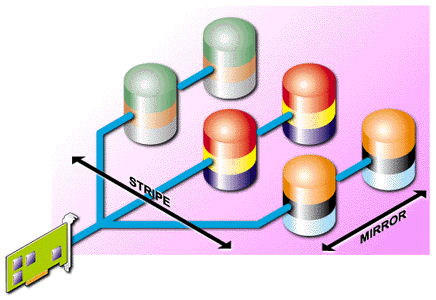
RAID 10: Three Level 1 RAIDs striped together as a RAID 0.